
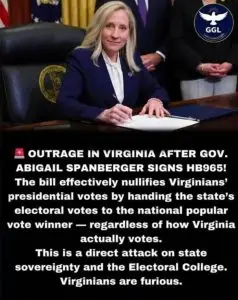
Virginia’s HB965 (enacted in 2026 as part of the National Popular Vote Interstate Compact, or NPVIC) raises significant constitutional questions under both federal and potentially state provisions. However, it has not been definitively ruled unconstitutional by courts. It is actively debated among legal scholars, with strong arguments on both sides.
What HB965 Does. HB965 enters Virginia into the NPVIC. Participating states (currently totaling around 222 electoral votes after Virginia’s addition) agree to award all their electoral votes to the candidate who wins the national popular vote (across all 50 states + DC), once states with a majority (270+ EVs) join. It only activates at that threshold. Virginia’s 13 EVs would thus go to the national winner, even if that candidate lost the popular vote in Virginia. The bill cites Article II of the U.S. Constitution as granting states plenary authority over the appointment of electors.
Federal Constitutional Issues 1. Compact Clause (U.S. Const. Art. I, § 10, Cl. 3): “No State shall, without the Consent of Congress… enter into any Agreement or Compact with another State.”
- The argument is that it violates this: The NPVIC is a binding interstate agreement that alters how presidential elections work nationally. It potentially encroaches on federal interests (e.g., reducing or eliminating the chance of contingent elections in the House under the 12th Amendment) and affects non-compacting states by diminishing their relative influence in the Electoral College. Supreme Court precedent (U.S. Steel Corp. v. Multistate Tax Comm’n, 1978; Virginia v. Tennessee, 1893) requires congressional consent for compacts that enhance member states’ power at the expense of federal supremacy or non-members. Critics (including some law professors and Heritage analyses) argue consent is required, and without it, the compact is invalid.
- Counterargument: It may not qualify as a “compact” needing consent if it doesn’t create a new interstate bureaucracy or truly encroach on federal power (per scholars like Akhil Amar). States already have broad authority individually. Proponents say it exercises existing powers collectively without new authority.
2. Article II, § 1 (Presidential Electors Clause):
“Each State shall appoint, in such Manner as the Legislature thereof may direct, a Number of Electors…”
- Argument it complies: This language is very broad (“plenary” power). States have used various methods historically (e.g., winner-take-all, district-based). Awarding EVs based on national popular vote is just another “manner.”
- Argument it violates (or exceeds) this: Historical practice and Framers’ intent (who rejected direct popular election) suggest electors should reflect the state’s electorate, not out-of-state votes. No state has ever before systematically appointed electors based on votes cast outside its borders. Some scholars argue this stretches “manner” beyond original understanding, effectively creating a direct popular election via state agreement rather than constitutional amendment (the proper process under Article V).
Other potential federal issues include impacts on the Guarantee Clause (Art. IV, § 4 — republican form of government) and equal protection concerns due to varying state voting rules in a “national” tally, though these are secondary.
Congressional consent could resolve some Compact Clause issues but might not fix Article II or structural arguments, and obtaining it is politically uncertain.
Virginia State Constitution Issues
Virginia’s Constitution (Art. I, § 1 et seq., and election provisions) generally defers to the legislature on elector appointment, mirroring federal language. The Code of Virginia already provides for popular election of electors who are pledged to state winners.
- HB965 changes this via statute to follow the national popular vote when the compact activates.
- Potential conflict: It could be challenged as undermining the state’s own popular election process or voter expectations under state law/constitution. However, because the legislature directs the “manner,” courts would likely defer unless it violates specific state rights (e.g., suffrage or equal protection under the Virginia Constitution). No clear violation stands out, but litigation is expected.
Overall Assessment and Practical Notes
- No definitive ruling: The compact has been enacted in multiple states without a successful court challenge. Challenges would likely arise only if/when it activates and affects an election, leading to major litigation (possibly reaching the Supreme Court). Issues like withdrawal timing, faithless electors (Chiafalo v. Washington), vote counting accuracy across states, and disenfranchisement claims would complicate enforcement.
- Supporters’ view: It’s a lawful exercise of state power to make elections more reflective of the national majority without amending the Constitution.
- Opponents’ view: It’s an end-run around the Electoral College and constitutional amendment process that could undermine federalism and state sovereignty.
In short, HB965 conflicts with plausible interpretations of the Federal Compact Clause and Article II (and possibly state provisions), creating a high risk of a successful legal challenge if implemented. It is not “clearly” unconstitutional on its face due to the broad language in Article II, but the interstate coordination aspect makes it vulnerable. Courts would ultimately decide. For the full bill text, see Virginia LIS.
SOURCES:
- https://lis.virginia.gov/bill-details/20261/HB965
- https://thevirginiacouncil.org/resources/understanding-virginias-hb965-the-national-popular-vote-compact-explained
- https://www.heritage.org/civil-rights/report/the-national-popular-vote-misusing-interstate-compact-bypass-the-constitution
- https://en.wikipedia.org/wiki/Constitutionality_of_the_National_Popular_Vote_Interstate_Compact
- https://digitalcommons.law.byu.edu/lawreview/vol2012/iss5/3/
- https://journals.law.harvard.edu/jol/2018/10/26/combination-among-the-states-npvic-unconstitutional/
- https://law.lis.virginia.gov/vacodefull/title24.2/chapter2.1/
- https://commons.stmarytx.edu/thestmaryslawjournal/vol53/iss4/7/